Virtual Try-On · 7 min
Virtual Try-On: The Difference Between Look, Fit, and Trust
The field lesson is not that shoppers reject virtual try-on. They reject a promise of fit accuracy when the product only delivers a useful visual reference.
Di Davide Mastricci, Founder · 8 agosto 2026
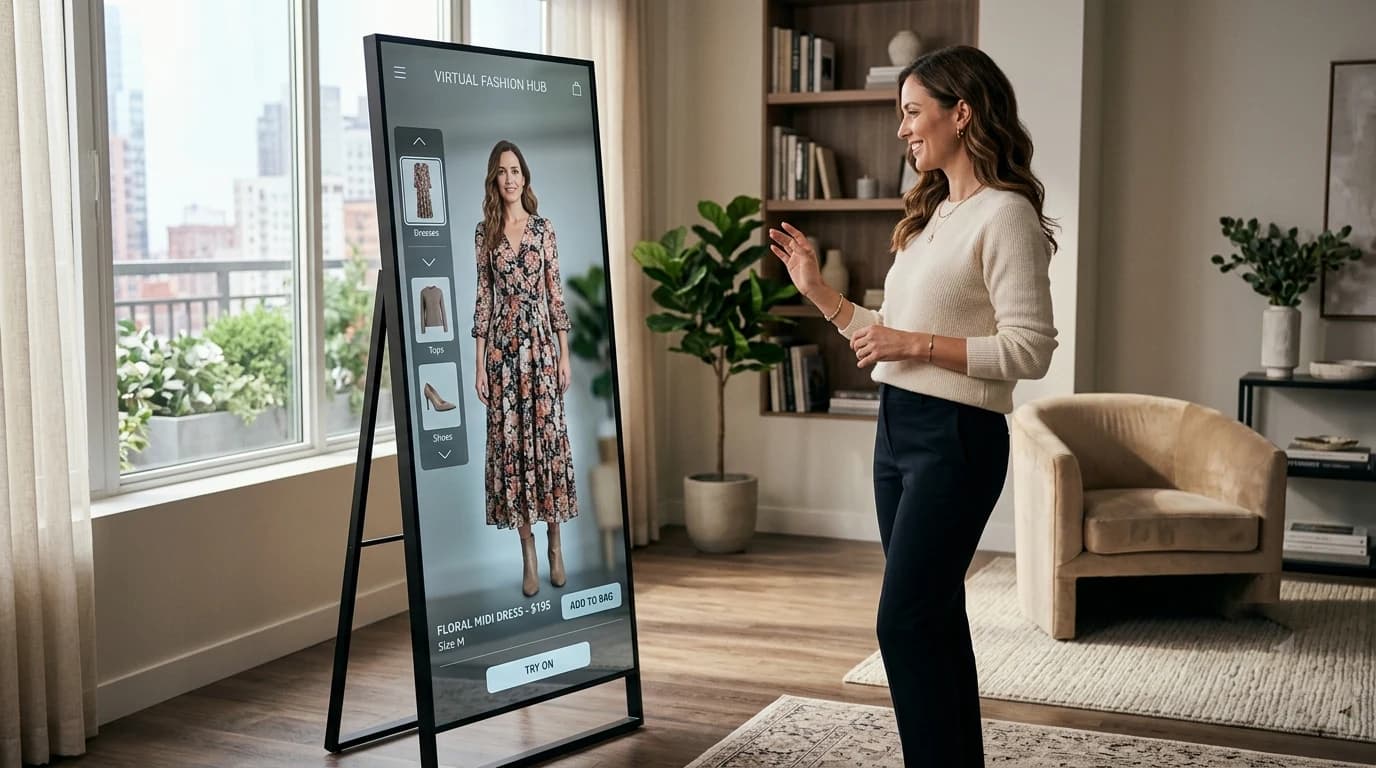
The field lesson: virtual try-on is not rejected because people do not want it
The most useful lesson from conversations about virtual try-on is easy to miss.
People are not rejecting the idea because they do not want to see a product on themselves. They reject it when the product promises confidence about fit, but delivers only a good visualisation.
That gap between the promise and the actual output is where trust breaks.
A virtual try-on image can be useful without being a digital tailor. The problem starts when shoppers are left to assume that a convincing image also proves the size, measurements, fabric, stretch, drape, or comfort will be right for them.
Three different questions are being mixed together
Look: “How would this garment look on me?”
This is the question virtual try-on can answer best.
A shopper wants to move beyond a product photo on a model or a flat lay. They want a better sense of colour, silhouette, proportions, and overall style on their own body and in their own context.
That is a meaningful reduction in uncertainty. It can help someone decide whether a product is worth considering in the first place.
Fit: “Will this actually fit me?”
This is a different question.
Fit depends on measurements, construction, fabric weight, elasticity, cut, and the relationship between a garment and a particular body. A generated image may suggest how an item sits, but it cannot reliably prove whether the sleeves will be long enough, the waistband will feel comfortable, or the fabric will stretch in the way the shopper expects.
An image can look right and still be wrong about fit.
Trust: “Can I rely on this enough to buy?”
Trust is the decision that sits between the first two questions.
Shoppers do not need a tool to be perfect before it becomes useful. They do need to understand what it can and cannot tell them. If a merchant presents visual output as a precise fit guarantee, a mismatch becomes a broken promise. If the merchant presents it as an additional reference alongside real product information, the same output can be helpful.
Trust comes from a clear boundary, not from pretending the boundary does not exist.
What shoppers seem willing to trust today
The strongest use case is visual uncertainty.
Shoppers can use try-on to explore colour, general silhouette, styling, and proportion. They can compare options more easily and get a more personal reference than a studio photo alone can provide.
They are less likely to treat the result as a reliable source for exact sizing, garment measurements, or comfort. Those questions still need a size chart, product measurements, fabric details, fit notes, and useful photos or video.
This is not a weakness that makes try-on pointless. It is a product boundary that should shape the way it is presented.
Category changes the value of the feature
The value of virtual try-on is not the same across every product category.
For glasses, makeup, hats, and some accessories, the visual question is often the main question. The shopper wants to know whether a frame, shade, or shape works with their face. The benefit can be immediate because the product is easier to evaluate visually.
Apparel is harder. The result depends on fabric, elasticity, construction, lighting, pose, camera angle, and body shape. The more a product's appeal depends on how it feels or moves, the less reasonable it is to present a visual result as proof of fit.
The right question is not “Does virtual try-on work?” It is “Which uncertainty does it reduce for this category and this product?”
The merchant lesson: add confidence, do not replace evidence
Virtual try-on should sit next to the information shoppers already need. It should not replace it.
Keep the product photos. Keep the videos. Keep the size chart. Keep the garment measurements and the notes about whether an item runs small, runs large, or is intended to fit loosely.
Then add try-on at the moment when a shopper is already interested and wants another piece of evidence.
The role is simple: help a shopper answer “How would this look on me?” without pretending to answer every question that comes after it.
Start with the products where uncertainty is visual
Installing try-on across an entire catalogue may sound obvious, but it is not the best first test.
Start with a small group of products where shoppers are likely to hesitate because they cannot picture themselves wearing them. That might be a particular silhouette, a colour with weak product photography, or a category where the visual decision comes before the fit decision.
Do not assume every product will benefit equally. Let the data show you where the feature earns attention and where it does not.
Measure the buying decision, not the widget click
A click tells you that a shopper was curious. It does not tell you that try-on helped them buy.
A better measurement plan follows the full path:
- Product viewed.
- Try-on used.
- Product added to cart.
- Product purchased.
- Return behaviour reviewed afterwards, where the store can connect the return reason to the product and order.
Compare shoppers on the same products, not try-on products against the entire catalogue. Review results by category and by product. Give the test enough time and volume to produce a useful signal.
And keep the interpretation honest. Shoppers who use try-on may already be more engaged than shoppers who do not. Any difference you observe is correlation, not proof of cause.
The goal is not to manufacture a flattering number. The goal is to learn where visual uncertainty is costing the store a decision, and whether try-on helps close that gap.
The standard we should aim for
Virtual try-on does not need to be a digital tailor to be valuable.
It needs to answer the question it is actually good at, make its limits clear, and arrive alongside the other evidence a shopper needs. For merchants, the best implementation is not the one with the most impressive promise. It is the one that improves confidence at the right moment and can be evaluated by category, add-to-cart, conversion, and returns.
Virtual try-on should add a layer of confidence when the shopper is already interested. It should not pretend to replace a size chart, a product video, or a tailor.
That is how the feature earns trust: by showing shoppers more, and promising them less than it can prove.