Industry · 6 min
Google Doppl Shut Down: What Shoppers and Stores Can Use Instead
Google retired its Doppl try-on app on April 30, 2026. Here is where selfie try-on lives now, for shoppers and for the stores they buy from.
By Davide Mastricci, Founder · July 30, 2026
What Doppl was
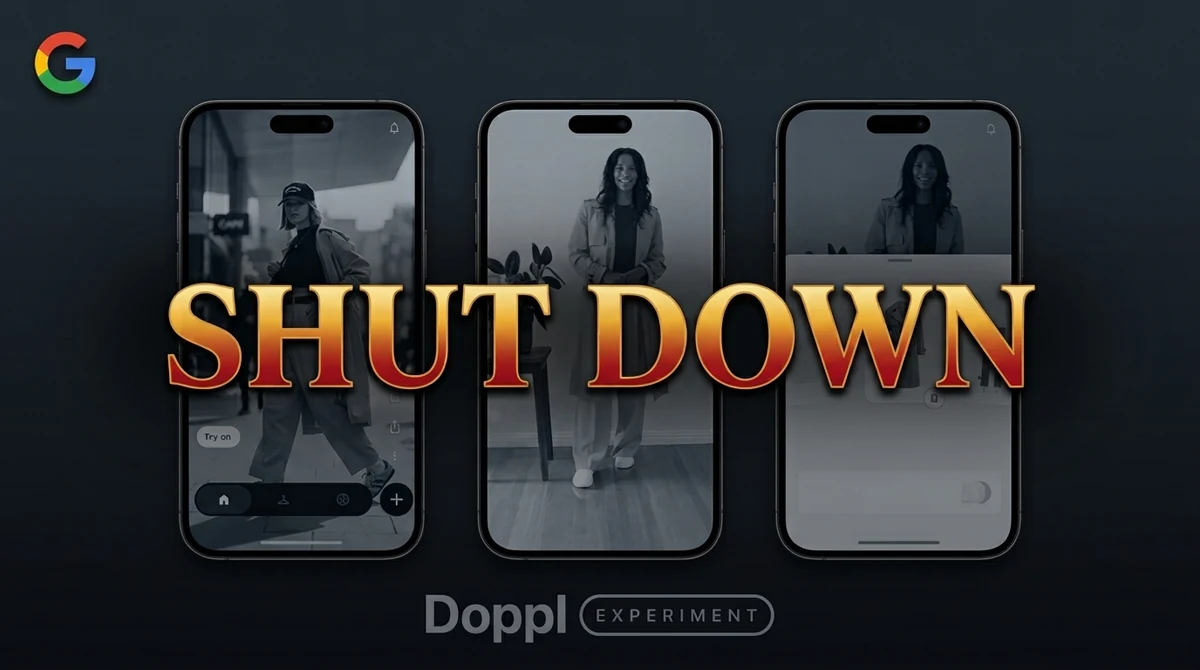
Doppl was a consumer app from Google Labs. It launched in June 2025, available only in the US, and the pitch was simple: upload one full-body photo of yourself, then try on outfits you found anywhere. A product page, a screenshot, an outfit you spotted online. Doppl generated an image of you wearing it.
It was not a merchant tool. There was no store integration, no dashboard, nothing for a seller to install. It was a shopper's toy in the best sense of the word: a fast, free answer to a question every online shopper asks.
The shutdown, plainly
Google shut Doppl down on April 30, 2026. The standalone app is gone. The technology did not disappear, though: Google folded it into the try-on features inside Google Search and Google Shopping. So the capability lives on, but inside Google's own shopping surfaces rather than as an app you open with any outfit you have found.
Those are the facts and the dates. Now the part I actually find interesting.
Why people loved it, and what the shutdown really means
Every apparel shopper carries the same question: how will this look on me? Product photos answer a different question, which is how the item looks on a model. Shoppers know the difference. "On the model" is not "on me", and no size chart or flat lay closes that gap.
Doppl answered the real question, and it answered it for the whole internet. Any outfit, from any source, on your own photo, in seconds. That is why it struck a chord far beyond the usual early-adopter crowd.
Google deserves genuine credit here. Doppl took a behavior that used to live in niche apps and scattered store widgets and put it in front of mainstream shoppers. When a Google product teaches millions of people that "show me this on my photo" is a normal thing to expect while shopping, that expectation does not vanish when the app does.
Which is the key point about the shutdown: the behavior did not die. It moved.
For shoppers: where selfie try-on lives now
If you used Doppl and miss it, the same idea now lives in two places.
- Inside Google Shopping. Google folded Doppl's technology into the try-on features in Search and Shopping, so you will increasingly meet it while browsing product listings there. The difference is context: instead of a standalone app that worked on any outfit you brought to it, try-on now shows up inside Google's shopping results.
- On individual stores' product pages. A growing number of stores run a try-on app directly on their site. You tap a button on the product page, upload one photo, and see the item on you before you decide. Not every store offers this yet, but when one does, it tends to sit right next to the buy button.
The trade-off between the two is worth spelling out. Google's version covers many products but lives inside Google. The store version exists only where a merchant installed it, but it works on that store's exact catalogue, so the image you get reflects the specific item you are about to order, right at the moment you are deciding whether to keep it in the cart.
For store owners: the expectation just landed on your product page
This is the part of the story that concerns you if you sell clothing online.
For ten months, a Google app trained shoppers to expect an answer to "how will this look on me". Some of those shoppers are now on your product page, picking their usual size and hoping for the best, and a growing share of them knows that a better answer exists because they have already seen it.
You can be the store that gives it to them. On Shopify, this is an app install, not a development project: a try-on app adds a button to your product page, the shopper uploads a selfie, and they get back an image of themselves wearing your product. The good ones install as a theme app embed with no code changes.
Full disclosure before I name names: I build one of these apps, so weigh everything below accordingly.
Aisthetix is our app: selfie-based apparel try-on for Shopify with revenue attribution built in. It tracks four funnel stages per product (viewed, used try-on, added to cart, purchased) and shows the attributed revenue, so you can judge from your own numbers whether the feature earns its keep. There is a free plan with 10 try-ons a month, Starter is $24.99 for 150, and every paid plan begins with a 30-day free trial capped at 50 try-ons. Two honest caveats: we launched in May 2026, so we have no reviews yet, and ours is not the cheapest entry price in the category.
Here are the alternatives I would look at alongside us, with prices as of July 2026:
- Antla offers selfie-based apparel try-on, with an entry plan at $19.99 per month for 100 try-ons, a cheaper entry than ours. Its listing shows no attributed-revenue reporting, which is the main thing we do differently.
- GenLook launched in September 2025 and offers a free tier of 10 try-ons per month plus a $19.99 starter for 100. It supports more than 40 storefront languages; its analytics focus on engagement rather than attributed revenue.
- Camweara is the longest-running app in the space, live since 2021, and works differently: real-time AR through your shopper's live camera. It is strongest for jewelry and eyewear, with apparel supported but secondary, and plans start at $39 per month.
If what you want to offer is the Doppl-style generative selfie try-on for clothing, the closest matches are the selfie-based apps: ours, Antla, and GenLook. Camweara is a different technique built for a different flagship category.
Whichever you pick, measure it. Compare purchase rates on the same product with and without try-on use, wait for a real sample, and treat the result as correlation, not proof of cause. If the numbers do not justify the subscription after a fair test, uninstall. That advice does not change when the app is ours.
Where to go next
We keep a full side-by-side of the options in our Google Doppl alternatives comparison, and the broader alternatives hub covers the rest of the try-on landscape. If you are ready to add try-on to your own store, the no-code Shopify install guide walks through the whole flow, and the best virtual try-on apps for Shopify roundup compares the field in more depth.
And to Google: thanks for mainstreaming the behavior. The rest of us will take it from here.